A practical systems guide for modern small businesses
Most small businesses begin with one person doing everything.
The founder answers emails, talks to customers, creates invoices, updates the website, handles marketing, and solves problems all day long.
At first, this feels normal.
But over time, many businesses unknowingly create a dangerous dependency:
The business cannot function efficiently without the owner constantly involved.
This creates:
- burnout,
- inconsistent growth,
- operational chaos,
- and limited scalability.
The businesses that become sustainable eventually make an important shift:
They stop operating purely on effort…
…and start operating through systems.
Today, thanks to cloud software, automation tools, and AI, even a solo founder can begin building a business that operates more like an organized enterprise.
This article explores how.
What Does “A Business That Works Without You” Actually Mean?
It does not mean the owner disappears completely.
It means:
- processes are documented,
- workflows are repeatable,
- customer information is organized,
- and daily operations no longer depend entirely on memory and manual effort.
The goal is not detachment.
The goal is:
- efficiency,
- predictability,
- and scalability.
Step 1: Stop Treating Every Task as Unique

One of the biggest problems in small businesses is that the same tasks are recreated repeatedly.
Examples:
- responding to inquiries,
- sending proposals,
- onboarding clients,
- generating invoices,
- publishing marketing content,
- scheduling meetings.
Without systems, founders make decisions from scratch every time.
That wastes energy.
Create Repeatable Workflows
Start identifying tasks that happen repeatedly.
Then create:
- templates,
- checklists,
- workflows,
- and standard procedures.
Examples:
Sales Process
Inquiry → consultation → proposal → invoice → onboarding
Content Workflow
Topic research → writing → graphics → SEO → publishing → social distribution
Client Onboarding
Signed contract → welcome email → intake form → kickoff meeting
Why This Matters
Once a process is documented:
- it becomes faster,
- easier to delegate,
- and easier to automate.
This is how businesses gradually transition from:
“everything depends on me”
to:
“the system supports the business.”
Step 2: Centralize Your Business Data

Many small businesses operate with scattered information.
Examples:
- leads inside email,
- invoices in accounting software,
- customer notes in spreadsheets,
- proposals in Word documents.
This fragmentation creates confusion and missed opportunities.
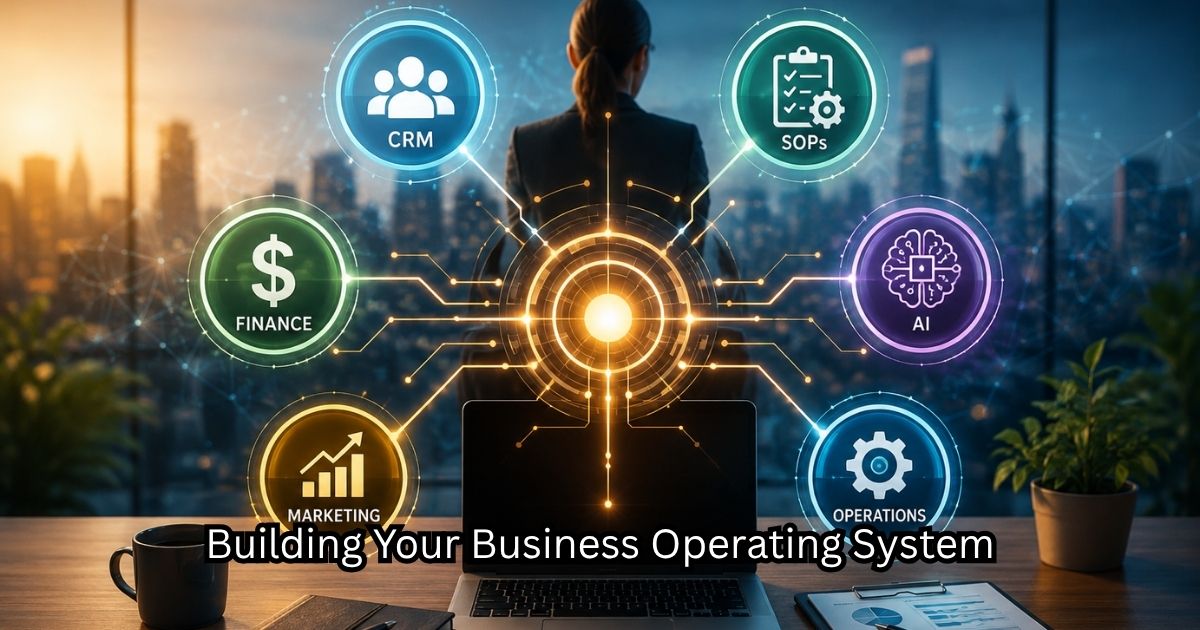
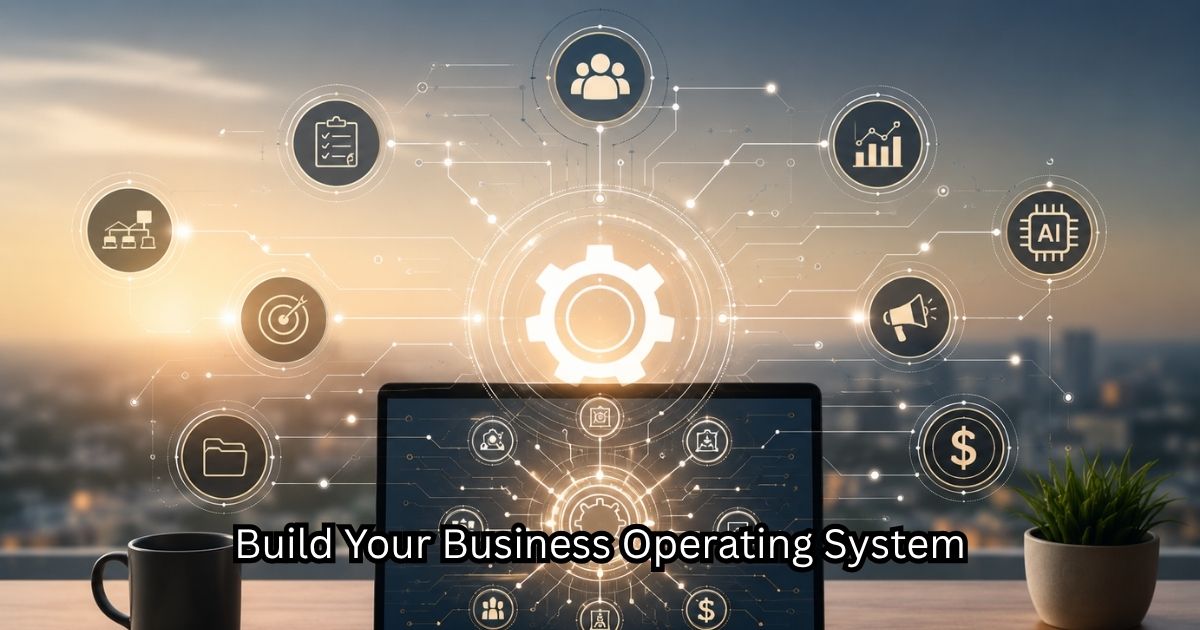
Modern businesses need a central operational hub.
Usually this becomes a CRM system.
CRM as the Central Business Database
A CRM (Customer Relationship Management system) organizes:
- prospects,
- leads,
- clients,
- communication history,
- tasks,
- and opportunities.
Recommended tools:
- HubSpot
- Zoho
- Pipedrive
Example CRM Structure
This creates visibility into the business pipeline.
Step 3: Automate Repetitive Tasks

One of the biggest advantages small businesses have today is automation.
Many repetitive tasks no longer require manual work.
Examples include:
- automatic lead capture,
- email follow-ups,
- invoice reminders,
- appointment scheduling,
- CRM updates,
- content publishing notifications.
Recommended Automation Tools
Example CRM Structure
Example Automation Workflow
Website Contact Form
↓
Lead automatically added to CRM
↓
Automated welcome email sent
↓
Consultation link shared
↓
Task created in project management system
The result:
- faster response time,
- better customer experience,
- less manual effort.
Step 4: Build Operational Systems

Most businesses focus heavily on marketing and sales.
But operational systems are equally important.
Operational systems include:
- project management,
- invoicing,
- file organization,
- communication workflows,
- client onboarding,
- internal documentation.
Recommended Operations Tools
Project Management
|
Tool
|
Best For
|
|---|---|
Accounting & Invoicing
|
Tool
|
Best For
|
|---|---|
Step 5: Use AI as a Productivity Multiplier

AI is changing how small businesses operate.
It allows small teams to perform work that previously required multiple employees.
Examples:
- writing content,
- generating proposals,
- brainstorming marketing ideas,
- summarizing meetings,
- customer support assistance,
- workflow planning.
Recommended AI Tools
Step 6: Think Like a Systems Designer

The biggest mental shift is this:
Do not just ask:
“How do I complete this task?”
Also ask:
“How do I create a repeatable system for this task?”
This mindset changes everything.
Example Business Ecosystem
Marketing
↓
Lead Generation
↓
CRM System
↓
Proposal / RFP
↓
Invoice
↓
Project Delivery
↓
Client Retention
When these pieces connect together, the business becomes:
- smoother,
- more scalable,
- and less stressful.
Final Thought
Many small businesses believe growth comes primarily from:
- working harder,
- doing more,
- and staying constantly busy.
But sustainable businesses are usually built differently.
They are built through:
- systems,
- structure,
- automation,
- and operational clarity.
The earlier these foundations are created, the easier growth becomes later.
That is how small businesses gradually evolve from:
owner-operated chaos
into:
organized modern enterprises